
Polar Coordinates in Calculus: Area, Double Integrals, and Arc Length
Use polar coordinates in calculus: area between polar curves, double integrals over circular regions, and arc length of polar curves, with worked examples and setup tips.
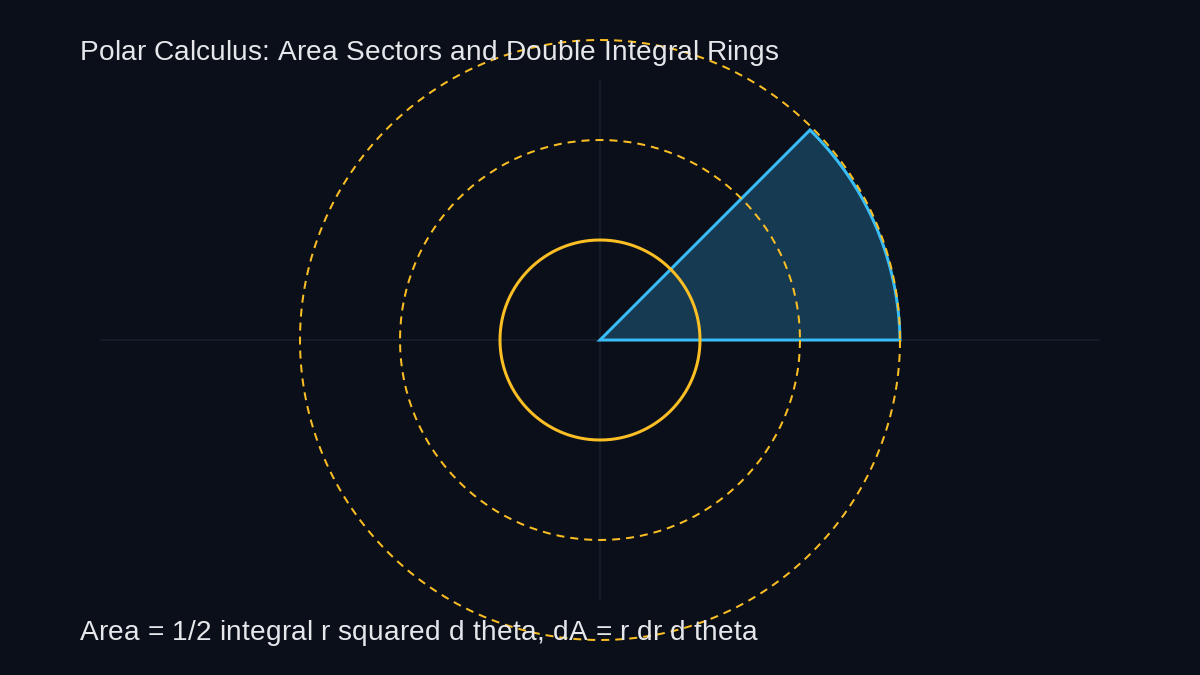
Polar coordinates simplify calculus problems with circular symmetry. Area, double integrals, and arc length all have polar versions, and each one exists because the Cartesian version becomes awkward when the region or curve is naturally described by radius and angle. The key ideas are the area element , the Jacobian factor in double integrals, and the arc length element .
Area Enclosed by a Polar Curve
The area enclosed by a polar curve between angles and is:
The factor comes from the area of a thin sector of angle and radius , which is .
Worked Example: Area Inside
For the circle , integrate over one full turn, to :
This matches the familiar Cartesian result , which is a good check that the polar area formula is set up correctly.
Worked Example: Area Inside the Cardioid
Integrate over one full turn:
Expand: . Over a full period, the integral of is , the integral of is , and the integral of is . So the integral is , and:
The cardioid with therefore encloses square units, less than the of the circle, even though both curves reach a maximum radius of .
Double Integrals in Polar Coordinates
To integrate a function over a circular region, convert with , , and . The extra factor is the Jacobian: it accounts for the fact that a small polar patch grows larger as increases.
Worked Example: Integral of Over a Disk of Radius 2
Evaluate over the disk of radius centered at the origin.
In polar form, , and , so the integrand becomes :
Without polar coordinates, the same integral needs split limits with square roots at the boundary. With polar coordinates, the limits are constants: from to , from to .
Worked Example: Volume Under Over a Disk of Radius 3
Find the volume under over the disk where , which is the disk of radius .
At : . So:
Forgetting the Jacobian factor is the most common error here: without it, the answer would be , less than a third of the correct volume.
Arc Length of a Polar Curve
The arc length of from to is:
Worked Example: Full Length of the Cardioid
Here , so:
Using , the square root simplifies to . Integrating over to :
The full cardioid with has length . In general, a cardioid has length , so this result matches the general rule with .
When to Switch to Polar Coordinates in Calculus
- The region is a disk, an annulus, a sector, or a cardioid: use polar limits, which become constants or simple functions of .
- The integrand contains : it collapses to , and with the Jacobian the integrand becomes a single-variable function of .
- The curve is given in polar form already: area and arc length formulas apply directly, with no conversion step.
- The region is rectangular or the integrand is separable in and : stay in Cartesian form, since polar coordinates would complicate the limits.
Frequently Asked Questions
Why is there an extra in a polar double integral?
Because a polar patch at radius with sides and has area . Patches farther from the origin are wider, so the area element must grow with . Omitting it undercounts the outer parts of the region.
Why is polar area and not ?
The area of a sector of angle and radius is , by the same proportion as a full circle: . Summing sectors gives the factor.
What are the limits for a full cardioid?
From to . The cardioid is traced exactly once over one full turn. Using to and doubling only works for curves symmetric in the right way, so for a first calculation, use the full to range.
How do I handle going negative in an area integral?
Trace the curve first and find the angles where . Split the integral at those angles, and use the absolute value of the traced region rather than integrating a signed blindly across a loop that is traced twice. For the curves in this guide, over the ranges used, so no split is needed.
Related Resources
• Rectangular to Polar Converter - Convert coordinates bidirectional online.
• Polar Graphing: Circles, Cardioids, Rose Curves, and Spirals - Graph the curves whose areas and lengths are computed here.
• Rectangular to Polar Formula Guide - Derivations and quadrant rules for the core formulas.
• Vectors and Phasors in Physics Problems - Vector addition in polar form, with physics applications.