
Vectors and Phasors in Physics Problems: Forces, Velocities, and AC Signals
Solve physics problems with vectors and phasors: resolve forces and velocities into components, add vectors in polar form, and add AC phasors with worked examples.
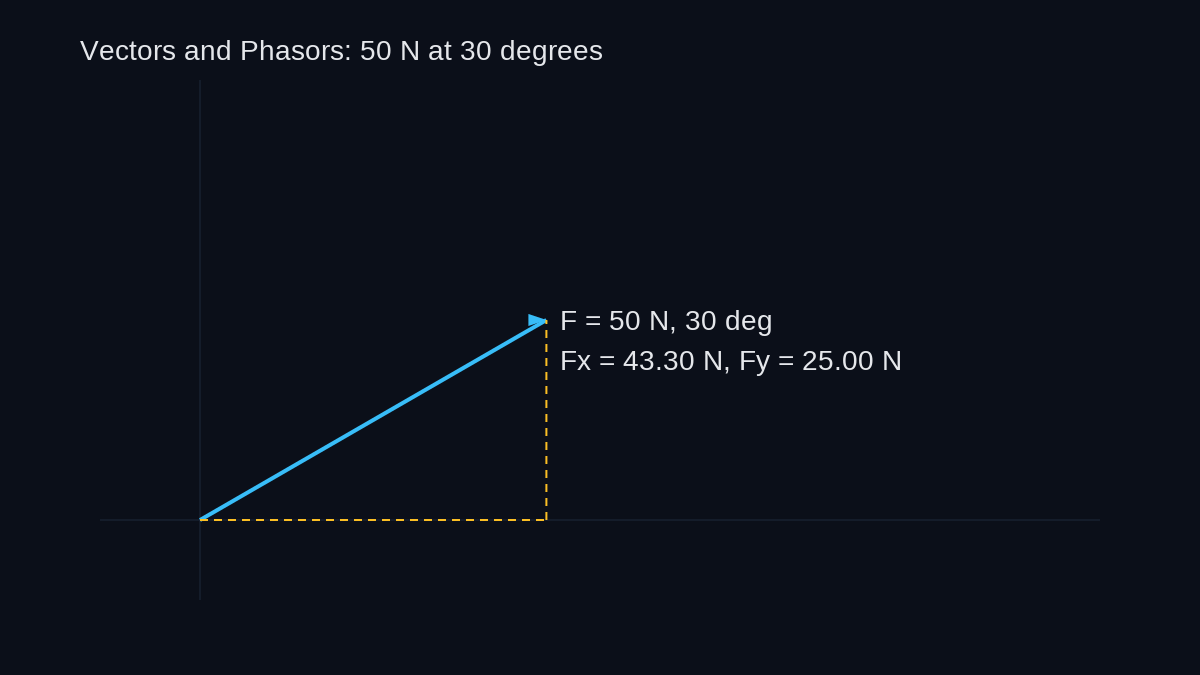
A vector has a magnitude and a direction, which is exactly what polar coordinates describe. In physics, the same conversion between rectangular and polar form appears in three places: forces and velocities resolved into components, several vectors added into one resultant, and alternating current signals represented as phasors. The mathematics is the same in all three cases; only the physical meaning of the numbers changes.
Resolving a Vector Into Components
A vector of magnitude at angle from the positive axis has components:
Going back the other way uses the polar conversion: and .
Worked Example: A 50 N Force at 30 Degrees
A force of N acts at above the horizontal.
- N
- N
So the force is N in component form. The horizontal component does the pulling along the surface, while the vertical component reduces the normal force, which is why the direction matters and not just the N magnitude.
Adding Two Vectors: The Resultant
To add vectors, add their components, then convert the sum back to polar form. Adding magnitudes directly only works when the vectors point in the same direction.
Worked Example: 30 N East and 40 N North
A N force acts east and a N force acts north.
- Sum of components: N
- Magnitude: N
- Direction: north of east
The resultant is N at . Note that would be wrong: the forces act at right angles, so they combine by Pythagoras, not by simple addition.
Velocities: Relative Motion in Polar Form
Velocity is also a vector, so the same method handles relative motion. A boat crossing a river, or an aircraft in a crosswind, has a velocity relative to the ground equal to the vector sum of its own velocity and the velocity of the medium.
Worked Example: Aircraft Velocity Plus Crosswind
An aircraft flies east at km/h relative to the air, while a wind blows north at km/h.
- Ground velocity components: km/h
- Ground speed: km/h
- Heading correction: north of east
The aircraft travels at km/h in a direction north of due east. To fly due east over the ground, the pilot would need to head slightly south of east to cancel the wind, which is the same calculation run in reverse.
AC Phasors: Voltages and Currents as Rotating Vectors
In AC circuit analysis, a sinusoidal voltage or current is drawn as a phasor: a vector whose length is the peak (or RMS) value and whose angle is the phase. Adding phasors is vector addition, and converting between rectangular and polar form is how phasor sums are computed.
Worked Example: Adding Two Voltage Phasors
Two voltages in series are V and V.
- Rectangular forms: V, V
- Sum: V
- Magnitude: V
- Phase:
The total voltage is V at . Again, would be wrong, because the two voltages are out of phase and peak at different times.
Worked Example: Adding Two Current Phasors
Two branch currents are A and A.
- Rectangular forms: A, A
- Sum: A
- Magnitude: A
- Phase:
The total current is A at . This is the same 3-4-5 triangle as the force example above, which shows up repeatedly in physics because it is the simplest right triangle with integer sides.
Common Mistakes in Vector and Phasor Problems
- Adding magnitudes instead of components when vectors point in different directions.
- Forgetting that a phasor angle is a phase difference, not a physical direction in space, even though the mathematics is identical.
- Mixing peak and RMS values in one sum: both phasors must use the same convention before adding.
- Using plain instead of when the resultant lies in Quadrant II or III, which gives an angle off. The quadrant guide linked below explains this trap in full.
Frequently Asked Questions
What is the difference between a vector and a phasor?
A vector describes a physical quantity with magnitude and direction, such as force or velocity. A phasor describes a sinusoidal quantity with magnitude and phase, such as an AC voltage. The mathematics of adding them is the same; the physical interpretation is different.
Why convert a phasor sum back to polar form?
The polar form gives the two numbers an engineer needs directly: the total magnitude, for sizing wires and components, and the phase angle, for power factor and timing. The rectangular form is only an intermediate step in the calculation.
Can phasors be subtracted as well as added?
Yes. Subtract component by component, then convert back to polar form. For example, minus is , which is V at .
Does the 3-4-5 triangle always give 53.13 degrees?
Only when the sides are and with the angle opposite the side. The angle is . Swapping the sides gives instead.
Related Resources
• Rectangular to Polar Converter - Convert coordinates bidirectional online.
• Rectangular to Polar Formula Guide - Derivations and quadrant rules for the core formulas.
• Converting Complex Numbers to Polar - Modulus, argument, and Euler form for phasors.
• Rectangular to Polar Circuits - AC impedance, phasor diagrams, and reactive power.
• Understanding Quadrants and atan2 - Quadrant corrections for polar angles.