
Rectangular to Polar Formula: Derivations, Quadrant Rules & Solved Examples
Master the rectangular to polar formula r = √(x² + y²) and θ = atan2(y, x). Complete mathematical derivations, quadrant correction rules, and solved examples.
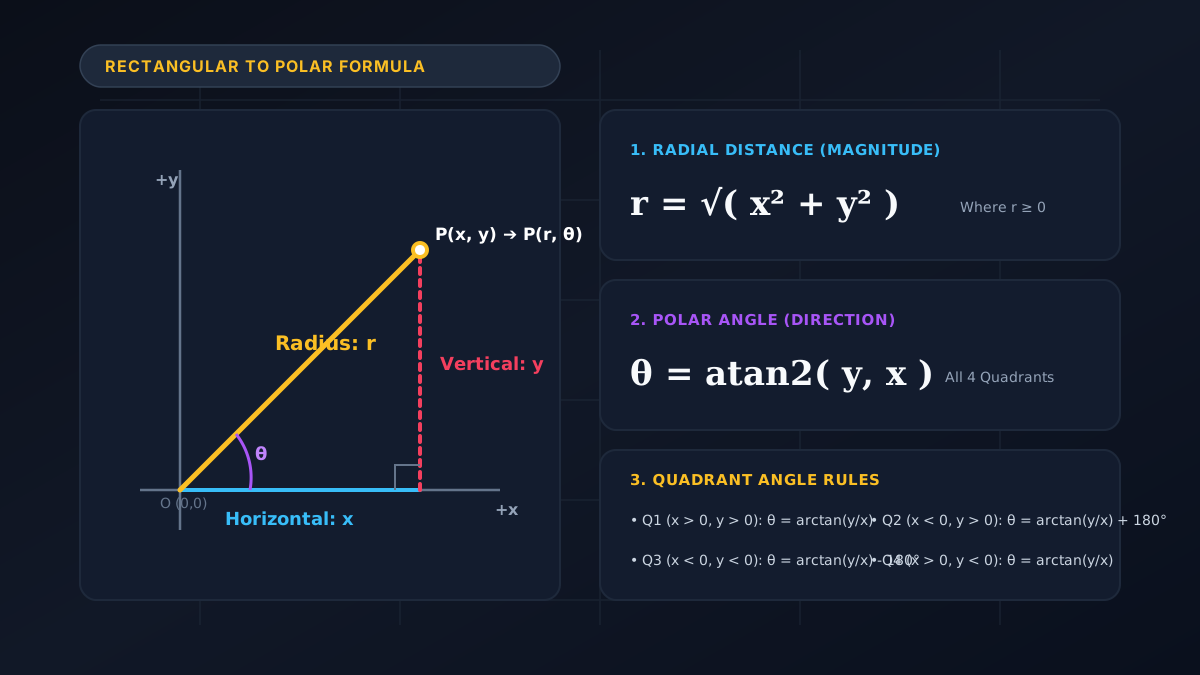
The rectangular to polar formula converts a two-dimensional Cartesian point into polar coordinates using two fundamental equations: the radial distance formula and the polar angle formula (or with quadrant corrections). The radius represents Euclidean distance from the origin (), while the angle represents the counterclockwise rotation from the positive x-axis.
Figure 1: Geometric breakdown and trigonometric derivation of the rectangular to polar formula.
Whether you are analyzing vectors in physics, designing navigation trajectories, or programming robotics, understanding how the rectangular to polar formula is derived and how to handle quadrant adjustments ensures 100% calculation accuracy. You can compute values instantly with our interactive rectangular to polar converter or explore bidirectional equations in our rectangular to polar and polar to rectangular guide.
The Two Core Rectangular to Polar Formulas
To transform any Cartesian coordinate pair into polar form , you apply two distinct mathematical equations:
1. Radial Distance (Magnitude) Formula
The radial magnitude measures the direct straight-line distance from the origin to the point . Derived from the Pythagorean theorem for a right-angled triangle with base and height :
Key rule: In standard mathematical convention, .
2. Polar Angle (Direction) Formula
The angle defines the directional bearing of the point measured counterclockwise from the positive horizontal x-axis:
Because standard arctangent () only produces angles between and ( to radians), you must adjust based on the Cartesian quadrant of , or use the computer science two-argument function .
Quadrant Adjustment Rules for the Angle Formula
When calculating the angle manually, apply the following quadrant rules to ensure reflects the true vector position:
| Quadrant | Coordinate Signs | Formula for (Degrees: ) | Formula for (Radians: ) |
|---|---|---|---|
| Quadrant I | |||
| Quadrant II | |||
| Quadrant III | |||
| Quadrant IV |
For an in-depth explanation of quadrant transitions and numerical implementations, read our detailed guide on understanding quadrants and atan2 in coordinate conversion.
Axis Boundaries and Special Edge Cases
When points lie directly along the coordinate axes ( or ), dividing leads to division by zero. The rectangular to polar formula handles these edge cases as follows:
- Positive X-axis : , ()
- Positive Y-axis : , ()
- Negative X-axis : , ()
- Negative Y-axis : , ( or )
- The Origin : , is mathematically undefined (conventionally set to ).
Step-by-Step Solved Examples
Example 1: Standard First-Quadrant Point
- Apply the radius formula:
- Apply the angle formula:
- Polar form:
Example 2: Second-Quadrant Point
- Calculate radial distance:
- Calculate raw arctangent:
- Apply Quadrant II correction ():
- Polar form:
Example 3: Third-Quadrant Point
- Calculate radial distance:
- Calculate angle with Quadrant III correction:
- Polar form: or
Mathematical Derivation of the Formula
The rectangular to polar formula is rooted in Euclidean geometry:
        P (x, y) = P (r, θ)
       /|
      / |
   r /  | y
    /   |
   / θ  |
  O-----|
x- Construct a right triangle with vertices at the origin , the horizontal projection , and point .
- By the Pythagorean theorem, .
- By the trigonometric definition of tangent, .
- Taking the inverse tangent yields .
To verify your manual calculations or test large coordinate arrays, you can use our interactive Rectangular to Polar Converter or study our comprehensive Step-by-Step Conversion Guide.
Frequently Asked Questions (FAQ)
What is the rectangular to polar formula?
The rectangular to polar formula transforms Cartesian coordinates into polar coordinates . The equations are for the radial distance and for the polar angle.
Why can’t I just use for all angles?
Because the basic function has a range of , it cannot differentiate between Quadrant I and Quadrant III (where ), or Quadrant II and Quadrant IV (where ). Quadrant adjustments or atan2(y, x) are necessary to produce the correct angle between and ( to ).
Can the radius in the rectangular to polar formula ever be negative?
In standard polar coordinate representations, the radial distance is always defined as non-negative (). While some advanced calculus contexts allow negative radii by flipping the angle by (), scientific calculators and computer algorithms output .
How does the rectangular to polar formula work on handheld calculators?
Scientific calculators provide a dedicated Pol( function (e.g., Pol(x, y) on Casio models). It computes and automatically using internal atan2 logic. Learn the exact button steps in our guide on how to convert rectangular to polar in Casio calculators.
Can I use these formulas to convert whole equations?
Yes. Substitute , and into the equation and simplify. Our guide on how to convert a rectangular equation to polar form works through 16 examples, including circles, lines, and parabolas.