
Rectangular to Polar and Polar to Rectangular: Two-Way Conversion Guide & Formulas
Complete guide to rectangular to polar and polar to rectangular conversions. Master bidirectional formulas (x, y) ↔ (r, θ), transformation tables, and physics examples.
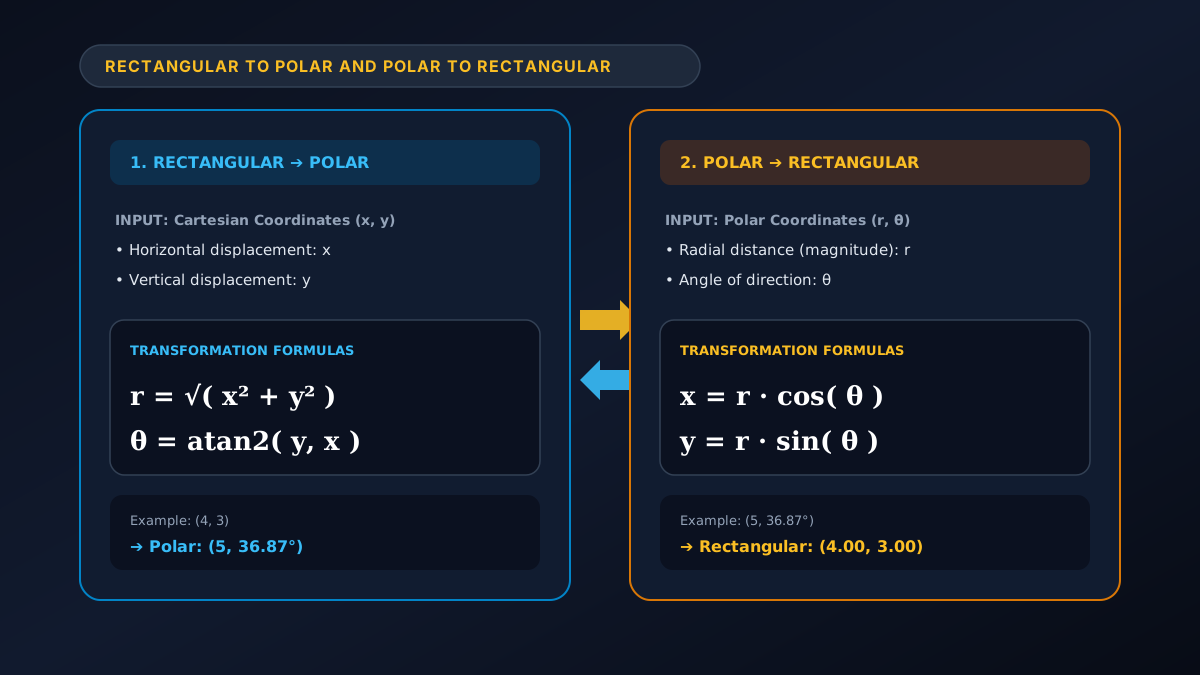
Converting between rectangular to polar and polar to rectangular coordinates is a core mathematical transformation in geometry, physics, and electrical engineering. In the rectangular (Cartesian) system, a point is defined by orthogonal distances , whereas in the polar system, the same point is defined by a radial distance from the origin () and a direction angle ().
Figure 1: Bidirectional mathematical transformations between Cartesian (x, y) and polar (r, θ) coordinate spaces.
Understanding both directions of this transformation allows you to move seamlessly between spatial grid modeling and circular/rotational dynamics. You can compute two-way conversions instantly on our online rectangular to polar converter or review the mathematical derivation in our rectangular to polar formula guide.
Bidirectional Conversion Formula Summary
Here is the quick-reference master table comparing both directions:
| Conversion Direction | Input | Output | Primary Formulas | Key Considerations |
|---|---|---|---|---|
| Rectangular Polar | Requires quadrant checking (add for ); . | |||
| Polar Rectangular | Straightforward multiplication; ensure calculator is in correct Deg/Rad mode. |
1. Rectangular to Polar: Step-by-Step
To transform from Cartesian grid points to polar coordinates :
- Calculate the Radius ():
- Calculate the Direction Angle ():
- Quadrant Rules for (Degrees):
- Quadrant I ():
- Quadrant II ():
- Quadrant III (): (or )
- Quadrant IV (): (or negative angle)
Example: Convert to Polar
- Result:
2. Polar to Rectangular: Step-by-Step
To transform from polar coordinates back to Cartesian grid points :
- Calculate the Horizontal Component ():
- Calculate the Vertical Component ():
Unlike the forward conversion, the reverse conversion has no quadrant ambiguities because the trigonometric sine and cosine functions automatically return the correct algebraic signs for any angle between and (or to ).
Example: Convert to Rectangular
- Result: (perfect round-trip verification)
Complete Verification & Solved Round-Trip Examples
| Starting Coordinate | Step 1: Forward Conversion | Step 2: Reverse Verification | Status |
|---|---|---|---|
| Verified | |||
| Verified | |||
| Verified | |||
| Verified |
Practical Applications of Two-Way Coordinate Systems
- AC Electrical Circuits & Phasor Analysis:
- Impedance addition is performed in rectangular form: .
- Impedance multiplication/division (Ohm’s Law) is performed in polar form: .
- Engineers constantly convert back and forth between rectangular and polar formats. Learn more in our rectangular to polar circuits guide.
- Navigation & Radar Tracking:
- Radar detectors capture targets using polar range and azimuth .
- Air traffic mapping software converts this into rectangular map coordinates for GPS alignment.
- Robotics & Kinematics:
- Robotic arm joints rotate along polar angular trajectories .
- End-effector tool tips target Cartesian coordinates in 3D workspaces.
When developing algorithmic software or modeling real-time sensor streams, executing bidirectional round-trip tests ensures that identity mappings preserve numerical accuracy within machine epsilon limits .
Frequently Asked Questions (FAQ)
What is the difference between rectangular and polar coordinates?
Rectangular coordinates specify a location using horizontal and vertical distances along perpendicular axes. Polar coordinates specify the same location using a direct radial distance from the origin () and an angle of rotation () from the reference axis.
Which conversion is easier: rectangular to polar or polar to rectangular?
Polar to rectangular () is generally easier because trigonometric functions directly handle all angle quadrants without requiring manual quadrant corrections. Rectangular to polar requires checking the signs of and to determine the true quadrant.
How do I convert between rectangular and polar on a Casio calculator?
Use the Pol( function for rectangular to polar (e.g. Pol(x, y)) and the Rec( function for polar to rectangular (e.g. Rec(r, θ)). See our dedicated guide on converting rectangular to polar in Casio calculators.
What software tools can perform these conversions automatically?
You can use our free rectangular to polar converter online or write programming scripts in MATLAB using cart2pol and pol2cart. See our rectangular to polar MATLAB tutorial.