
Polar Graphing: Circles, Cardioids, Rose Curves, and Spirals
Learn polar graphing from scratch: circles, cardioids, rose curves, and spirals, with worked examples, symmetry checks, and plotting tips for each curve type.
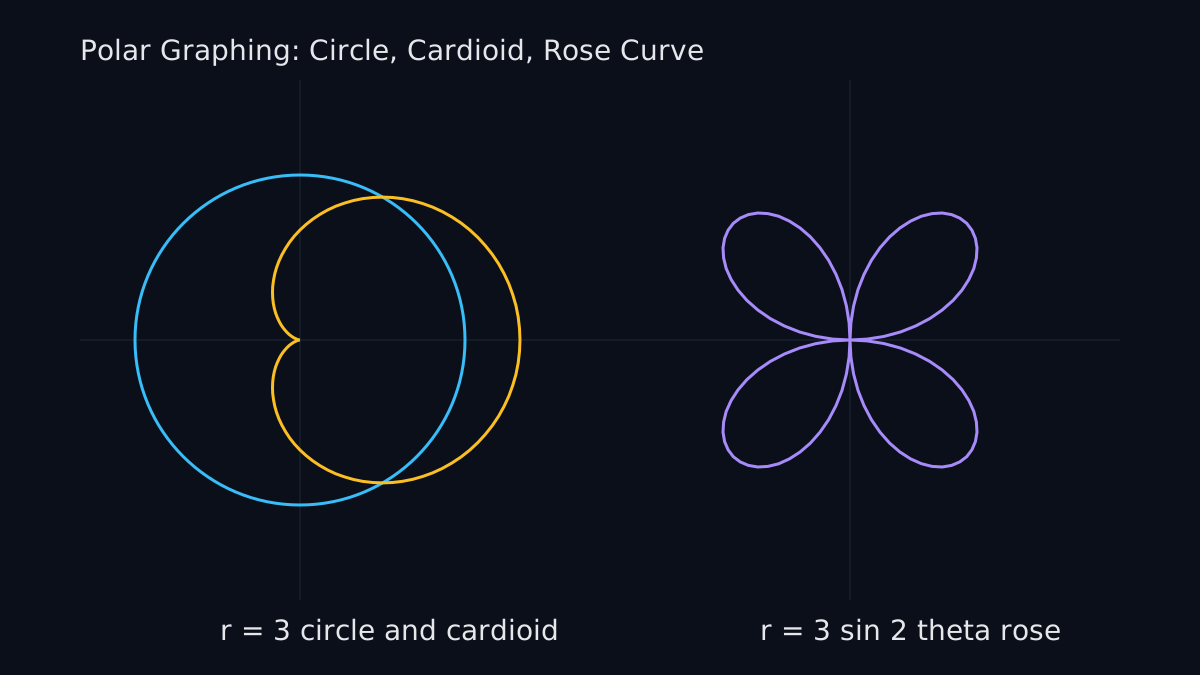
Polar graphing turns an equation in and into a shape. Instead of plotting against , you plot a distance in a direction . Four curve families cover most of what students and engineers meet: circles, cardioids, rose curves, and spirals. Each one has a recognizable equation form, a symmetry test, and a small set of key points that fix the whole graph.
Circles in Polar Form
A circle centered at the origin is the simplest polar graph: , a constant. Every point is units from the origin, in every direction.
Circles shifted off the origin use cosine and sine:
- is a circle of radius centered at on the axis.
- is a circle of radius centered at on the axis.
Worked Example:
Plot the key points of :
- : point , which is in Cartesian form.
- : point , which is .
- : point , which is .
- : point , which is .
Joining these points gives a circle of radius centered at the origin. Its Cartesian equation is .
Cardioids: Heart-Shaped Curves
A cardioid has the form or , with the sign variants and . The name comes from the heart-like shape: the curve passes through the origin at one angle and reaches its maximum distance in the opposite direction.
Worked Example:
Evaluate at the four cardinal angles:
- : , point .
- : , point , which is .
- : , the origin. This is the cusp of the heart shape.
- : , point , which is .
The curve bulges out to on the right, pinches to the origin on the left, and is symmetric about the axis. Replacing with would flip the cusp to the right instead.
Rose Curves: Petals From Sine and Cosine
A rose curve has the form or . The number of petals depends on :
- If is odd, the rose has petals.
- If is even, the rose has petals.
- The petal length is .
Worked Example:
Here , which is even, so the rose has petals, each of length .
- : , point , which is .
- : , point . Converting: and , so the point is . The negative radius flips the point to the opposite quadrant, which is how the fourth petal forms.
- : , the origin, where petals meet.
A common mistake is to count petals for . The even rule gives , and plotting the negative radius values is what reveals the extra petals.
Spirals: Radius That Grows With Angle
A spiral has a radius that changes as changes. The Archimedean spiral (with in radians) grows steadily: each full turn adds the same amount to the radius.
Worked Example:
Take in radians:
- : , the origin.
- : , point , which is .
- : , point , which is .
- : , point , which is .
After one full turn the spiral is units from the origin, twice its distance after half a turn. That steady growth is the signature of an Archimedean spiral, unlike a logarithmic spiral, where the radius grows by a fixed factor per turn.
How to Plot Any Polar Equation by Hand
- Build a small table of values: , , , , , , , .
- Compute for each angle, and keep negative values as they are: they plot in the opposite direction.
- Mark the key points: maximum , minimum , and every angle where .
- Check symmetry before drawing: if replacing with leaves the equation unchanged, the graph is symmetric about the axis; if replacing with leaves it unchanged, it is symmetric about the axis.
- Join the points smoothly, following the order of increasing , so petals and loops appear in the right places.
Frequently Asked Questions
How many petals does have?
Three petals. Here , which is odd, so the petal count equals . Each petal has length .
What does a negative mean on a polar graph?
A negative radius plots the point in the opposite direction: is the same point as . Negative values are normal in rose curves and must not be dropped, or petals will go missing.
How is a cardioid different from a circle?
A cardioid reaches at one angle, giving it a cusp at the origin. A circle also passes through the origin, but it is a full circle with no cusp, centered at .
Why does a spiral need radians, not degrees?
The equation only gives the standard steady growth when is measured in radians, because a full turn is radians. In degrees the same equation would grow far too fast and would not match the Archimedean spiral definition.
Related Resources
• Rectangular to Polar Converter - Convert coordinates bidirectional online.
• Rectangular to Polar Formula Guide - Derivations and quadrant rules for the core formulas.
• Convert a Rectangular Equation to Polar - Turn Cartesian equations into polar form, and back.
• Understanding Quadrants and atan2 - Quadrant corrections for polar angles.