How to Convert a Rectangular Equation to Polar Form (and Back) with 16 Worked Examples
Convert rectangular equations to polar form and polar equations to rectangular form. Three substitution rules, step-by-step examples for circles, lines, parabolas and hyperbolas, plus common mistakes.
Quick answer: To convert a rectangular equation to polar, replace every x with rcosθ, every y with rsinθ, and every x2+y2 with r2, then solve for r. To convert a polar equation to rectangular, multiply or rearrange until you can replace rcosθ with x, rsinθ with y, and r2 with x2+y2.
Example: x2+y2=36 becomes r2=36, so the polar equation is r=6.
Converting a single point such as (3,4) is a calculation, and our rectangular to polar calculator does it instantly. Converting an equation such as y=x2 is algebra: you are rewriting the description of an entire curve. This guide covers that algebra with 16 worked examples, eight in each direction.
The Conversion Rules
Every conversion uses the same small set of identities. They come from the right triangle formed by a point, the origin, and the x-axis (see rectangular to polar formulas for the derivation).
Rectangular
Polar
Use it when you see…
x
rcosθ
a lone x
y
rsinθ
a lone y
x2+y2
r2
a sum of squares (circles)
xy
tanθ
a ratio, or a line through the origin
Going the other way, you look for these same groupings in the polar equation: rcosθ→x, rsinθ→y, r2→x2+y2, and r=x2+y2.
Part 1: Rectangular Equation to Polar Equation
Method
Substitute x=rcosθ and y=rsinθ. Replace x2+y2 with r2 wherever it appears.
Simplify, using identities such as cos2θ+sin2θ=1.
Solve for r if possible. If you divide by r, check whether the pole (r=0) still lies on the curve.
Example 1: Circle centered at the origin, x2+y2=36
x2+y2=36⇒r2=36⇒r=6
A circle of radius 6 around the origin is simply r=6. The same method gives x2+y2=64⇒r=8 and x2+y2=25⇒r=5. We use r=6 rather than r=±6 because r=−6 traces the same circle.
Example 2: Horizontal line, y=5
rsinθ=5⇒r=sinθ5=5cscθ
Example 3: Vertical line, x=3
rcosθ=3⇒r=3secθ
Example 4: Line through the origin, y=x
rsinθ=rcosθ⇒tanθ=1⇒θ=4π
A line through the origin has no r in its polar equation. Every point on it has the same direction. Negative values of r cover the half of the line in Quadrant III.
Example 5: Line not through the origin, y=x+1
rsinθ=rcosθ+1⇒r(sinθ−cosθ)=1⇒r=sinθ−cosθ1
In general, the line ax+by=c becomes r=acosθ+bsinθc.
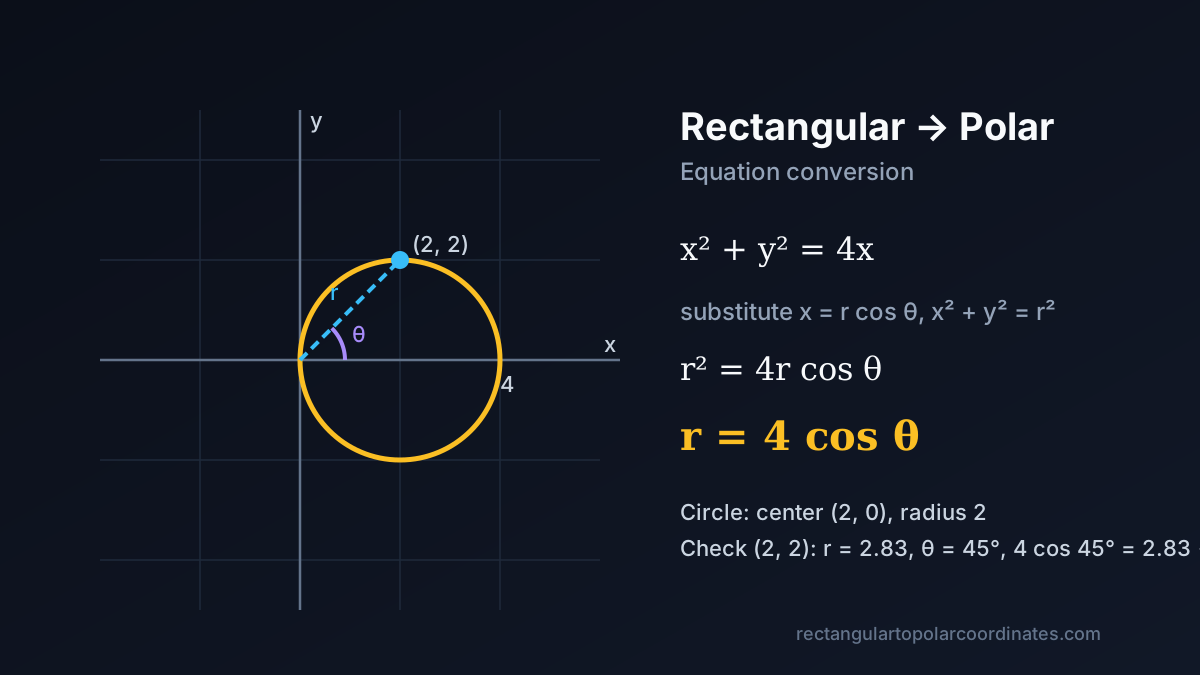
Example 6: Circle through the origin, x2+y2=4x
r2=4rcosθ⇒r=4cosθ
We divided by r, which could lose the solution r=0. But r=4cosθ reaches r=0 at θ=2π, so the pole is still included. This is a circle of radius 2 centered at (2,0).
Example 7: Circle through the origin, x2+y2=6y
r2=6rsinθ⇒r=6sinθ
This is a circle of radius 3 centered at (0,3). More generally, x2+y2+Dx+Ey=0 becomes r=−Dcosθ−Esinθ.
Both use double-angle identities: 2sinθcosθ=sin2θ and cos2θ−sin2θ=cos2θ.
Part 2: Polar Equation to Rectangular Equation
Method
Look for rcosθ, rsinθ or r2 already in the equation.
If they are not there, multiply both sides by r (or rearrange) to create them.
Replace them with x, y and x2+y2, then simplify. Complete the square to identify circles.
Example 9: r=4
r2=16⇒x2+y2=16
A circle of radius 4 centered at the origin.
Example 10: θ=3π
tanθ=tan3π=3⇒xy=3⇒y=3x
Example 11: r=2secθ
r=cosθ2⇒rcosθ=2⇒x=2
Example 12: r=4sinθ
Multiply both sides by r:
r2=4rsinθ⇒x2+y2=4y⇒x2+(y−2)2=4
A circle of radius 2 centered at (0,2).
Example 13: r=6cosθ
r2=6rcosθ⇒x2+y2=6x⇒(x−3)2+y2=9
A circle of radius 3 centered at (3,0).
Example 14: r=sinθ+cosθ2
rsinθ+rcosθ=2⇒y+x=2
A straight line with slope −1 and y-intercept 2.
Example 15: r=1−cosθ1
r−rcosθ=1⇒r=1+x⇒x2+y2=(1+x)2⇒y2=1+2x
A parabola opening to the right. Squaring both sides of r=1+x is safe here because r≥0 and 1+x=r≥0 on this curve.
Example 16: r2=4sin2θ (lemniscate)
r2=8sinθcosθ⇒r4=8(rsinθ)(rcosθ)⇒(x2+y2)2=8xy
We multiplied both sides by r2 so that each sinθ and cosθ gets its own factor of r.
Summary Table
Rectangular equation
Polar equation
Shape
x2+y2=a2
r=a
Circle at origin
x=a
r=asecθ
Vertical line
y=b
r=bcscθ
Horizontal line
y=mx
θ=arctanm
Line through origin
x2+y2=2ax
r=2acosθ
Circle through origin, center (a,0)
x2+y2=2by
r=2bsinθ
Circle through origin, center (0,b)
y=x2
r=tanθsecθ
Parabola
x2−y2=1
r2=sec2θ
Hyperbola
Common Mistakes
Substituting r for x2+y2. The correct replacement is r2. Only x2+y2 equals r.
Dividing by r without checking the pole. In r2=4rcosθ, dividing by r removes the solution r=0. It is safe only if the simplified equation still passes through the pole, as r=4cosθ does at θ=2π.
Writing θ=arctan(y/x) for every point. Inside an equation, tanθ=y/x is fine. When you need an actual angle for a specific point, arctan alone gives the wrong quadrant for x<0. Use atan2.
Forgetting to complete the square.x2+y2=4y is correct but hides the shape. x2+(y−2)2=4 shows the center and radius.
Squaring without checking signs. Squaring both sides can add points that are not on the original curve. Check the sign condition, as in Example 15.
A quick way to test a converted equation is to pick a point on the original curve, convert it, and confirm it satisfies the new equation.
For Example 6, the point (4,0) lies on x2+y2=4x because 16+0=16. Converting it with our online calculator gives r=4,θ=0∘. Plugging into r=4cosθ gives 4cos0=4, so the conversion checks out.
Frequently Asked Questions
What is the polar form of x2+y2=36?
r=6. Replace x2+y2 with r2 to get r2=36, then take the positive root.
How do you convert y=x to polar form?
Substitute to get rsinθ=rcosθ, so tanθ=1 and θ=4π (45°).
How do you convert r=4sinθ to rectangular form?
Multiply both sides by r to get r2=4rsinθ, then substitute to get x2+y2=4y, which is the circle x2+(y−2)2=4.