
Rectangular to Polar Calculator: How Online Converters Work, Accuracy & Guide
Discover how a rectangular to polar calculator computes radius r and angle θ. Learn about precision control, degree/radian modes, atan2 algorithms, and fast conversions.
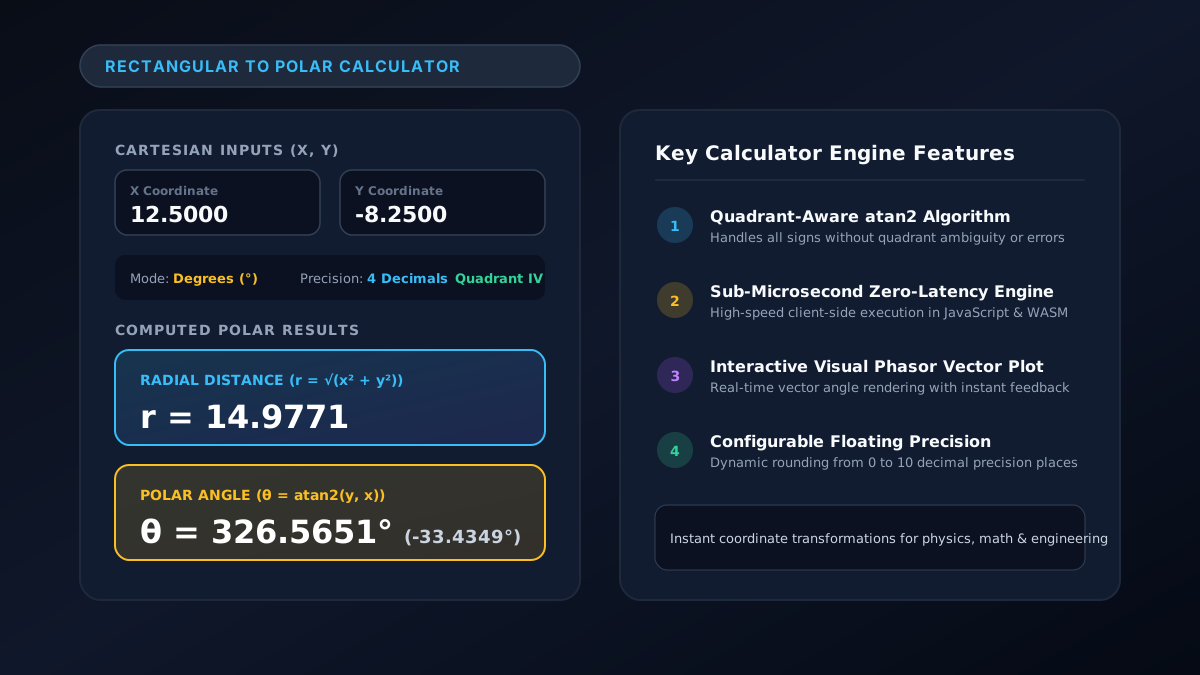
A rectangular to polar calculator is an interactive computational tool that converts two-dimensional Cartesian coordinates $(x, y)$ into polar coordinates $(r, \theta)$ in real time. It applies the Pythagorean theorem $r = \sqrt{x^2 + y^2}$ to calculate radial distance and the two-argument arctangent function $\theta = \text{atan2}(y, x)$ to evaluate the exact directional angle without quadrant ambiguity.
Figure 1: Internal computation engine and user interface layout of a modern rectangular to polar calculator.
Whether you are verifying physics homework, solving AC circuit phasor problems, or developing navigation algorithms, using a dedicated rectangular to polar calculator eliminates manual trigonometric sign errors. Try our free rectangular to polar calculator tool directly on the homepage or review the underlying rectangular to polar formula.
How a Rectangular to Polar Calculator Works
Modern web calculators and embedded scientific calculation engines execute coordinate transformations using a multi-stage mathematical pipeline:
[ Cartesian Inputs: x, y ]
            │
            ├──► Radial Distance: r = √(x² + y²)
            │
            ├──► Quadrant Determination: Sign Check of (x, y)
            │
            ├──► Polar Angle: θ = atan2(y, x)
            │
            └──► Formatting: Decimal Precision & Deg/Rad Mode Selection
1. High-Precision Radius Computation
The calculator computes the Euclidean norm $r = \sqrt{x^2 + y^2}$. To avoid arithmetic overflow or underflow when computing very large or microscopic values, robust calculators implement the IEEE-754 hypot(x, y) function:
$$\text{hypot}(x, y) = |x|\sqrt{1 + \left(\frac{y}{x}\right)^2}$$
2. Quadrant-Aware Angle Resolution
Standard calculators that rely only on $\arctan(y/x)$ fail on negative x-values and division by zero. A modern rectangular to polar calculator utilizes the atan2(y, x) function, which evaluates the signs of both $x$ and $y$ independently to place the angle accurately across all four quadrants:
| Quadrant | Signs | Computed Angle Range (Degrees) | Range (Radians) |
|---|---|---|---|
| Quadrant I | $x > 0, y > 0$ | $0^\circ < \theta < 90^\circ$ | $0 < \theta < \frac{\pi}{2}$ |
| Quadrant II | $x < 0, y > 0$ | $90^\circ < \theta < 180^\circ$ | $\frac{\pi}{2} < \theta < \pi$ |
| Quadrant III | $x < 0, y < 0$ | $180^\circ < \theta < 270^\circ$ (or $-180^\circ < \theta < -90^\circ$) | $-\pi < \theta < -\frac{\pi}{2}$ |
| Quadrant IV | $x > 0, y < 0$ | $270^\circ < \theta < 360^\circ$ (or $-90^\circ < \theta < 0^\circ$) | $-\frac{\pi}{2} < \theta < 0$ |
Core Features of an Advanced Online Coordinate Calculator
When choosing an online coordinate converter, look for these vital capabilities:
- Instant Client-Side Computation: Calculates results with 0ms latency directly inside the browser using optimized JavaScript.
- Precision Rounding Control: Ability to toggle decimal precision from 0 to 10 decimal places for academic and engineering precision.
- Radian & Degree Toggle: Instant switching between angular units with exact $\pi$ fractional representations.
- Interactive Phasor / Vector Graph: Visual display showing the vector magnitude line and angular arc on a Cartesian plane.
- Bidirectional Transformation: Quick toggle between rectangular-to-polar and polar-to-rectangular conversion modes.
Step-by-Step Calculation Guide Using the Calculator
Follow these three simple steps to convert any point using our online calculator:
- Enter Your Coordinates: Input your horizontal $x$ and vertical $y$ values in the input fields (positive or negative decimal numbers are supported).
- Select Angular Unit: Click Degrees (°) or Radians (rad) depending on your project requirements.
- Adjust Precision: Use the + and − buttons to choose your desired decimal accuracy (e.g., 4 decimal places). The polar coordinates $(r, \theta)$ update instantly.
Worked Example Table
| Cartesian Input $(x, y)$ | Radial Distance $r$ | Angle $\theta$ (Degrees) | Angle $\theta$ (Radians) | Quadrant |
|---|---|---|---|---|
| $(4, 3)$ | $5.0000$ | $36.8699^\circ$ | $0.6435\text{ rad}$ | Quadrant I |
| $(-5, 12)$ | $13.0000$ | $112.6199^\circ$ | $1.9656\text{ rad}$ | Quadrant II |
| $(-8, -6)$ | $10.0000$ | $216.8699^\circ$ ($-143.13^\circ$) | $-2.4981\text{ rad}$ | Quadrant III |
| $(7, -24)$ | $25.0000$ | $343.7397^\circ$ ($-16.26^\circ$) | $-0.2838\text{ rad}$ | Quadrant IV |
Why Online Calculators Outperform Manual Methods
Manual trigonometric coordinate conversion is prone to several common pitfalls:
- Forgetting to add $180^\circ$ when $x < 0$ (Quadrant II & III errors).
- Calculator mode mismatches (entering calculations in radians while expecting degree results).
- Intermediate rounding errors that accumulate when converting multi-step physics problems.
An online calculator guarantees instant validation, visual verification, and step-by-step mathematical breakdowns. For custom digital calculation platforms, web applications, and algorithmic tools, explore the software engineering services of Shahab Dev.
Frequently Asked Questions (FAQ)
What is a rectangular to polar calculator?
A rectangular to polar calculator is a specialized digital tool that transforms 2D Cartesian coordinates $(x, y)$ into polar form $(r, \theta)$, giving the magnitude and directional angle with quadrant corrections.
How do I use a rectangular to polar calculator for complex numbers?
In electrical engineering and algebra, a complex number $z = a + jb$ is equivalent to a Cartesian point $(x=a, y=b)$. Entering $a$ and $b$ into the calculator yields the phasor magnitude $|z| = r$ and phase angle $\theta = \angle z$. Read more in our guide on rectangular to polar circuits.
Does the calculator handle negative coordinates?
Yes. The calculator uses the atan2 algorithm to automatically handle negative $x$ and $y$ coordinates, adjusting the angle into the proper quadrant ($0^\circ$ to $360^\circ$ or $-180^\circ$ to $+180^\circ$).
Can I convert back from polar to rectangular coordinates?
Yes! You can use our bidirectional tool to convert $(r, \theta)$ back to $(x, y)$ using $x = r\cos(\theta)$ and $y = r\sin(\theta)$. See our full rectangular to polar and polar to rectangular guide.